Amritsar — Travel Guide
Amritsar (the sacred spiritual capital of Sikhism, the historic heart of Punjab, and one of the world's most revered pilgrimage destinations), was founded in 1577 by Guru Ram Das Ji — the fourth Sikh Guru — around a holy pool named Amrit Sarovar, meaning the Pool of Nectar. Renowned worldwide for hospitality, deep spirituality, and rich Punjabi culture, Amritsar attracts millions of pilgrims and travelers every year.
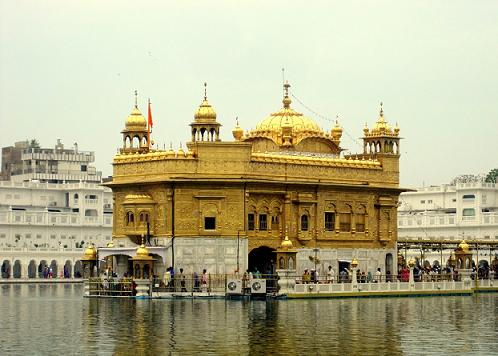
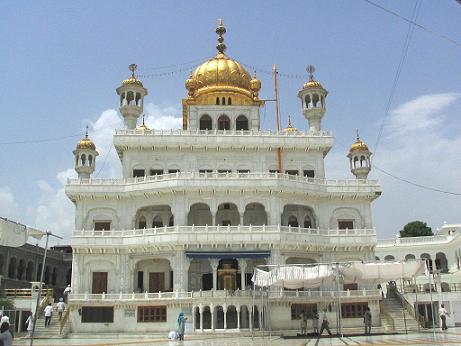
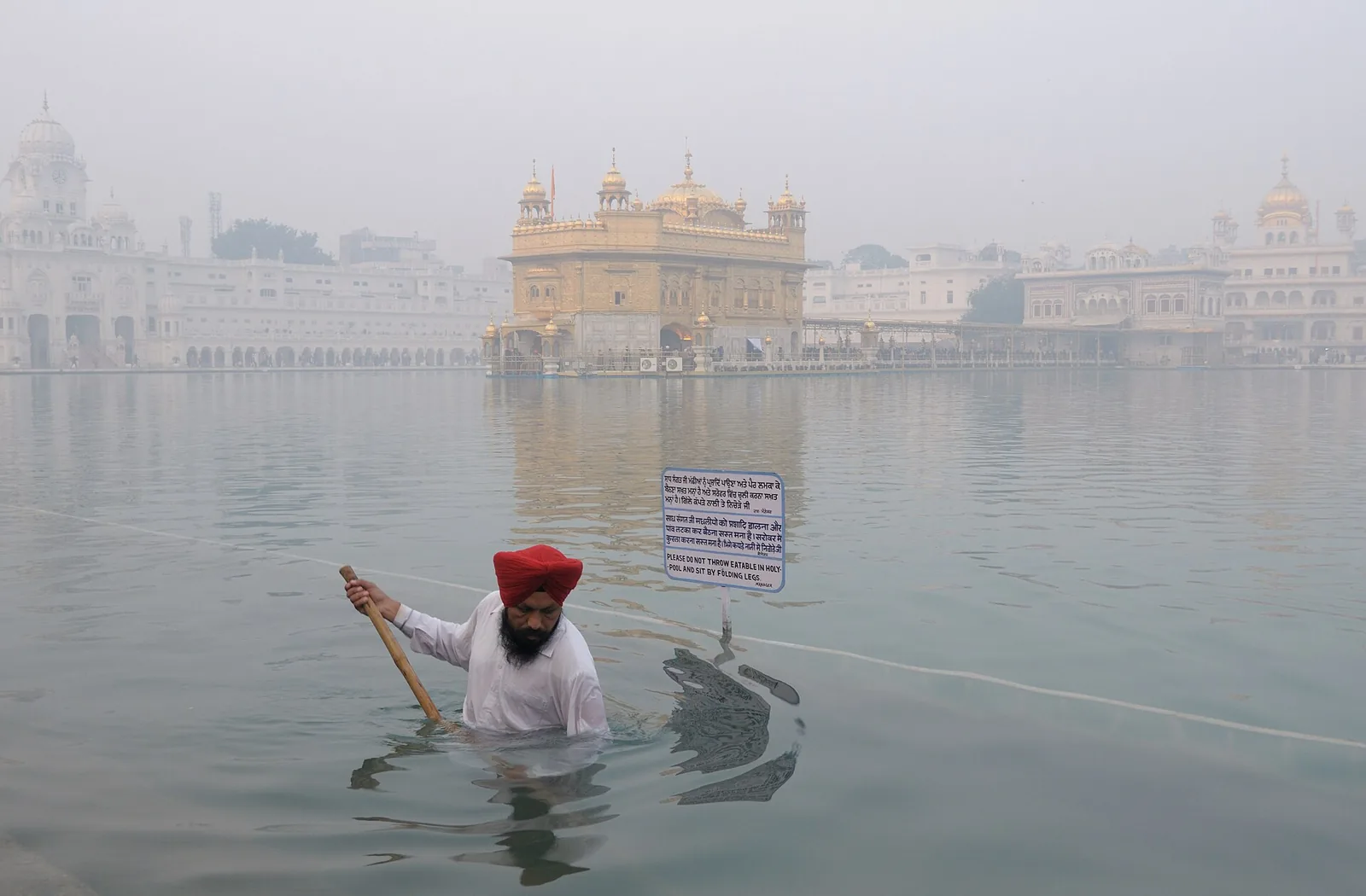 The Gold Plated Sanctum and Amrit Sarovar Reflections of the Golden Temple in Amritsar
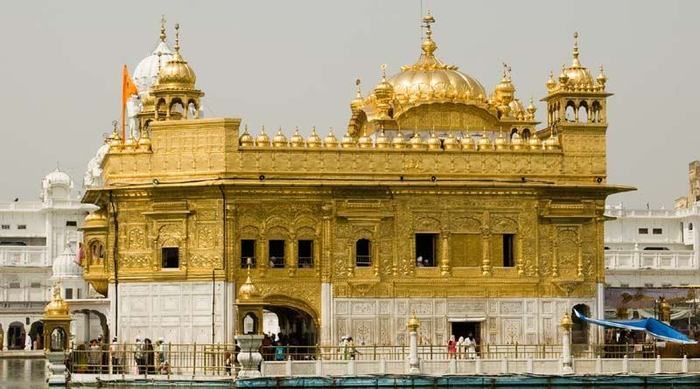
The city's spiritual centerpiece is the Golden Temple (Sri Harmandir Sahib) — a two story marble and copper shrine covered in 500 kg of pure gold foil, surrounded by the holy Amrit Sarovar. The temple welcomes people of all faiths through four open entrances, and its community kitchen (Guru Ka Langar) serves over 100,000 free hot vegetarian meals every single day.
Just steps away lies the historic ground of Jallianwala Bagh, preserving the Martyr's Well and bullet scarred walls from the 1919 massacre, alongside the moving exhibits of the Partition Museum at Town Hall. Each evening, the Attari-Wagah Border (28 km) draws thousands of spectators for the high energy Beating Retreat ceremony between Indian and Pakistani border guards.
Amritsar also showcases the military ramparts of Gobindgarh Fort, the sacred Durgiana Temple, and the ancient hermitage of Ram Tirth. Connected by Sri Guru Ram Dass Jee International Airport, high speed Vande Bharat trains, and national highways just 260 km from Katra and 215 km from Jammu, Amritsar offers travelers deep spiritual peace, patriotic energy, and legendary Amritsari kulchas.
Best Time to Visit Amritsar:
- October to March (Winter & Autumn / Peak Sightseeing Season): Daytime temperatures range from 14°C to 25°C with clear sunny days and cool evenings. This is the best time for temple parikrama, attending the evening Wagah border ceremony, and exploring Heritage Street.
- April to June (Summer): Daytime temperatures range from 34°C to 44°C. Early morning visits to the Golden Temple (before 8 AM) and evening visits (Palki Sahib ceremony at 9:30 PM) are recommended.
- July to September (Monsoon): Moderate showers bring fresh greenery across the Majha plains, with temperatures between 28°C and 35°C.
- Diwali & Bandi Chhor Divas: Celebrated with unmatched grandeur as the entire Golden Temple is illuminated with 100,000 oil lamps and fireworks.
Famous Amritsari Culinary Delicacies:
- Authentic Amritsari Kulcha: Crispy multilayered tandoori flatbread stuffed with spiced potatoes and cauliflower, brushed with desi ghee and served with spicy chickpea curry and tangy tamarind onion chutney.
- Guru Ka Langar Dal & Kheer: Simple, nourishing, and spiritually blessed lentil stew, hot rotis, and rice pudding served 24/7 in the community kitchen.
- Amritsari Fried Fish: Fresh river sole fish marinated in gram flour, carom seeds, red chillies, and lemon juice, fried crisp and served with green chutney (Lawrence Road).
- Creamy Malai Lassi: Thick sweet churned yogurt topped with a dollop of fresh milk cream, served chilled in large earthen clay cups (*kulhad*).
- Saffron Jalebis & Pinni: Hot crispy spiral jalebis soaked in saffron syrup and traditional winter sweet pinni made with wheat flour, desi ghee, almonds, and gond.
By Air:
Sri Guru Ram Dass Jee International Airport (Airport Code: ATQ - 11 km northwest of city center) operates scheduled direct domestic flights to New Delhi, Mumbai, Bengaluru, Srinagar, Ahmedabad, and Pune, alongside direct international flights to London, Birmingham, Dubai, Sharjah, Doha, Singapore, and Kuala Lumpur. Prepaid taxis and app based cabs operate 24/7 from the terminal.
By Train:
Amritsar Junction Railway Station (Station Code: ASR - 2 km from Golden Temple) connects with express rail services across India:
- Vande Bharat Express & Swarna Shatabdi Express: Connects New Delhi (NDLS) to Amritsar in 5 to 6 hours with executive AC chair car service.
- Golden Temple Mail (Train 12903): Daily direct express service connecting Mumbai Central to Amritsar.
- Direct superfast trains connect Katra, Jammu Tawi, Haridwar, Kolkata, and Chennai.
- Free 24/7 dedicated electric bus shuttles run continuously between Amritsar Railway Station and Sri Harmandir Sahib.
By Road:
- From New Delhi (~450 km / 7 hours): 6-lane NH-44 / Grand Trunk Road through Panipat, Ambala, and Jalandhar.
- From Katra (~260 km / 4.5 hours): Direct 4-lane highway drive via Pathankot and Gurdaspur.
- From Jammu (~215 km / 4 hours): Smooth drive via NH-44.
- From Chandigarh (~230 km / 3.5 hours): 4-lane expressway via Ludhiana and Jalandhar.
- Interstate Buses: Punjab Roadways (PUNBUS) and PRTC operate round the clock Volvo AC and deluxe buses to Amritsar ISBT.
Shopping in Amritsar's Hall Bazaar, Katra Jaimal Singh, and Heritage Street is famous for authentic Punjabi textiles, footwear, and savory snacks:
- Authentic Handcrafted Phulkari: Traditional geometric silk floss embroidered dupattas, shawls, suits, and jackets from Katra Jaimal Singh.
- Handcrafted Punjabi Juttis: Hand stitched leather mojris and juttis decorated with golden tilla embroidery, beads, and mirrors from Raunak Bazaar.
- Amritsari Papad & Spiced Warian: Sun dried black pepper papads and spicy urad dal warian from historic spice merchants in Majith Mandi.
- Sikh Spiritual Keepsakes: Handcrafted steel kadas, miniature ceremonial swords, carved wooden combs, and Gurbani music recordings from the temple complex.
- Pure Desi Ghee Sweets & Dry Fruits: Gift boxes of Dodha, Besan Pinni, and dry fruit Karachi Halwa from Kanha Sweets and Bansal Sweets.
Must-Visit Places in Amritsar
Amritsar features a world famous collection of Sikh shrines, national independence memorials, border ceremonies, and historic forts:
1. Golden Temple (Sri Harmandir Sahib) & Holy Amrit Sarovar (Spiritual Heart of Sikhism)
Surrounded by a 5.1-meter-deep sacred water tank (*Amrit Sarovar*), Sri Harmandir Sahib is the holiest shrine in Sikhism. Designed with four entrances signifying universal brotherhood, the two story marble sanctum was gilded with 500 kg of 24-karat gold foil by Maharaja Ranjit Singh in 1830. The complex includes the central causeway (*Guru's Bridge*), the historic *Akal Takht* (seat of Sikh temporal authority), the Sikh Central Museum, and *Guru Ka Langar*, which feeds over 100,000 pilgrims daily.
Golden Temple — Sri Harmandir Sahib and Sacred Amrit Sarovar Pilgrimage Complex
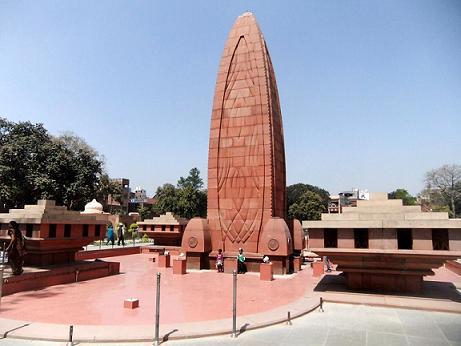
2. Jallianwala Bagh National Memorial & Historic Martyrs' Well (1919 Memorial)
Located near the Golden Temple, this 6.5-acre public garden is a sacred national memorial to the hundreds of unarmed Indian civilians killed on April 13, 1919, by British troops under General Dyer. The site preserves the historic entrance alley, the bullet scarred brick walls, the *Martyrs' Well* (where hundreds jumped to escape gunfire), the eternal flame (*Amar Jyoti*), and an interactive gallery.
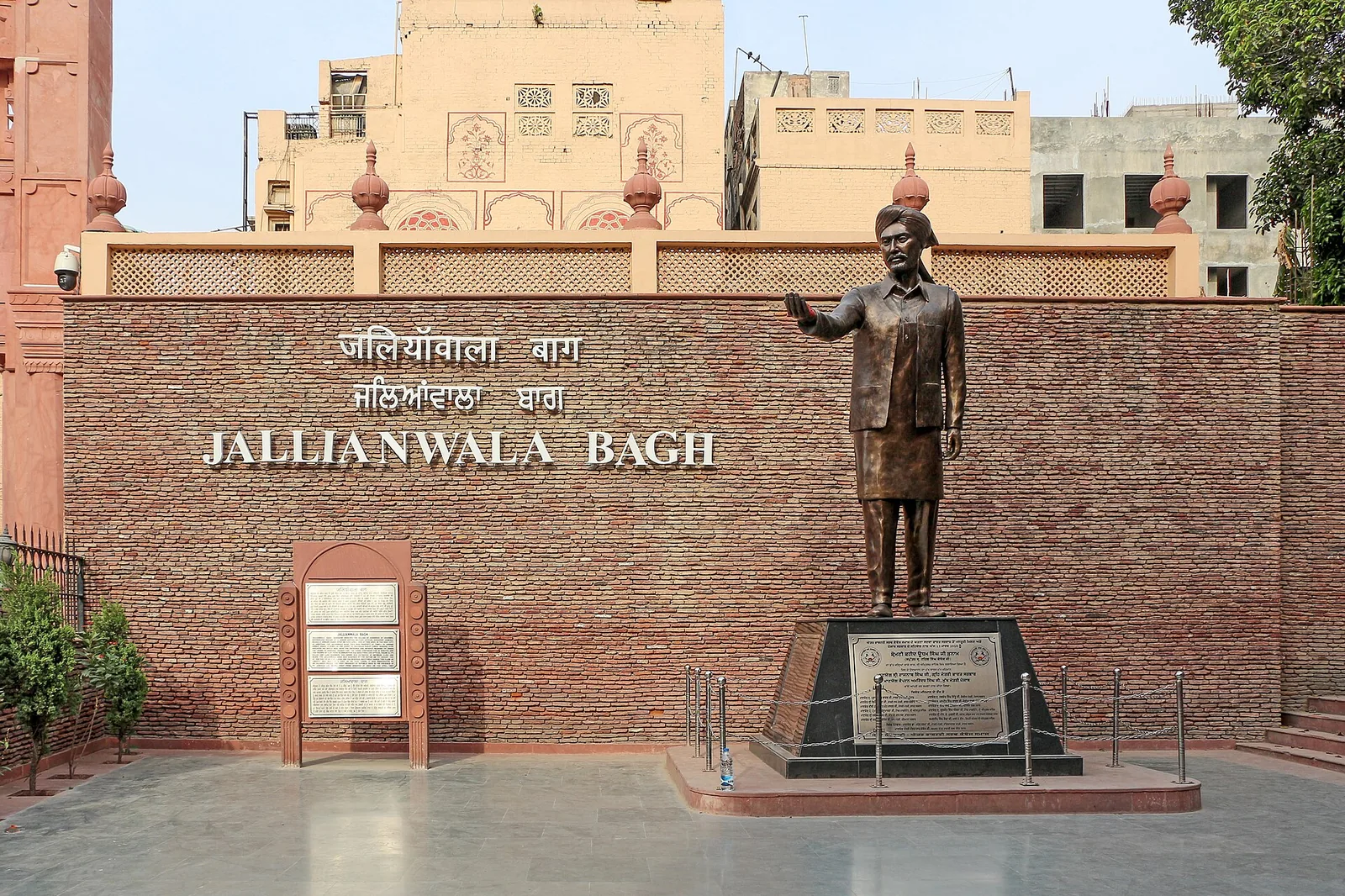 Jallianwala Bagh — Historic National Memorial and Bullet-Scarred Heritage Site in Amritsar
3. Attari-Wagah Border Beating Retreat & Flag Lowering Ceremony (28 km)
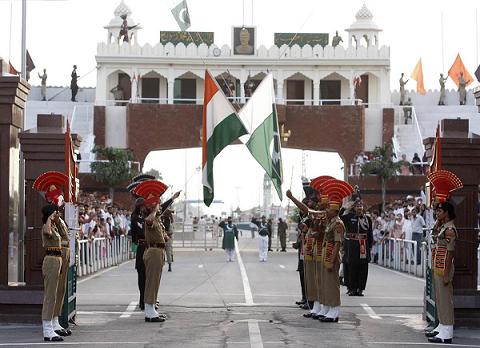
Situated 28 km west of Amritsar on the Grand Trunk Road at the international border between India and Pakistan, the Attari-Wagah Border hosts a daily military flag lowering and Beating Retreat ceremony at sunset. Conducted with precision by the Border Security Force (BSF) and Pakistan Rangers, the 45-minute display features high kicking drills, patriotic anthems, and stadium crowds.
 Attari-Wagah Border — Daily Beating Retreat and Flag-Lowering Military Ceremony
4. Gobindgarh Fort & Maharaja Ranjit Singh Military Citadel (18th Century)
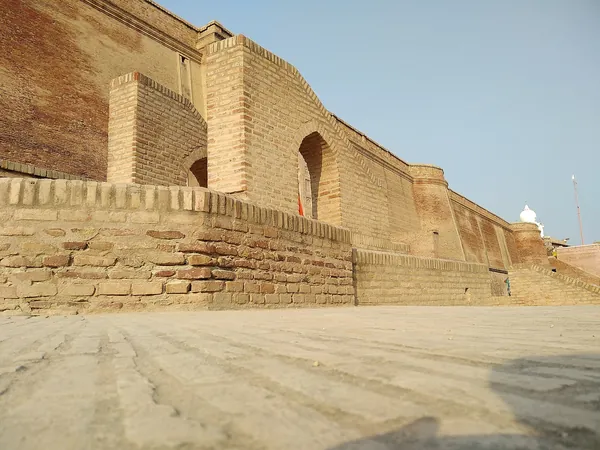
Constructed in the 1760s by the Bhangi Misl rulers and reinforced in 1805 by Maharaja Ranjit Singh, this 43-acre square brick fortress guarded the Sikh Empire's treasury (*Toshakhana*), where the Kohinoor diamond was once kept. Today, it functions as a living heritage museum with ancient cannons (Zamzama), military museums, Punjabi folk dances, and the *Whispering Walls* laser light and sound show.
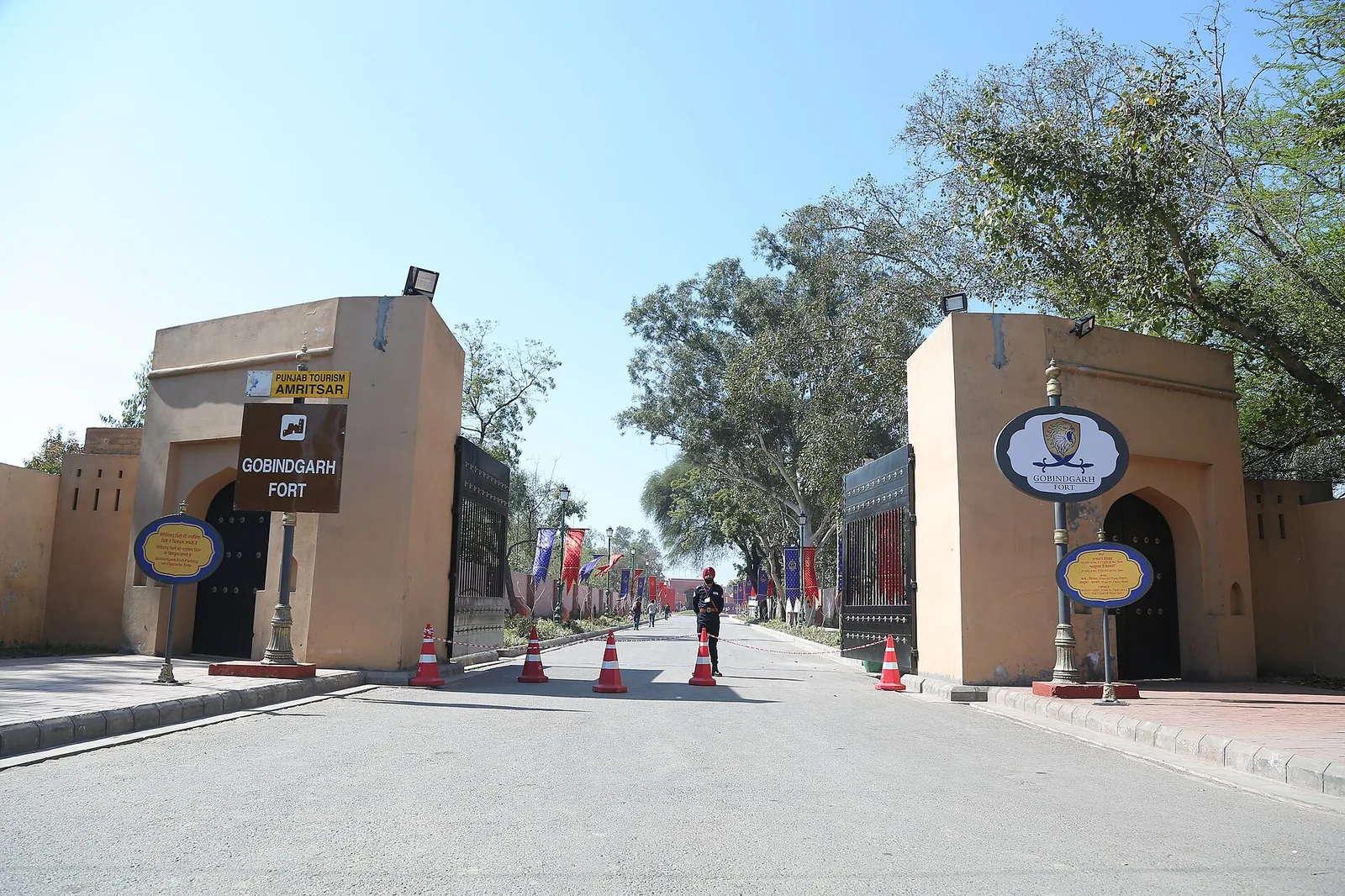 Gobindgarh Fort — 18th-Century Sikh Military Fortress and Living Heritage Museum
5. Durgiana Temple (Lakshmi Narayan Silver Temple & Holy Sarovar)
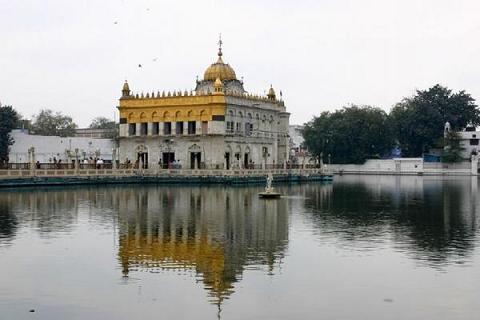
Built in 1921 in an architectural style inspired by the Golden Temple, this 16th-century Hindu temple is dedicated to Goddess Durga and Lord Vishnu. Situated in the center of a holy water tank, the temple is famous for its engraved silver doors (*Silver Temple*), marble causeway, and annual Langur Mela festival during Navratri.
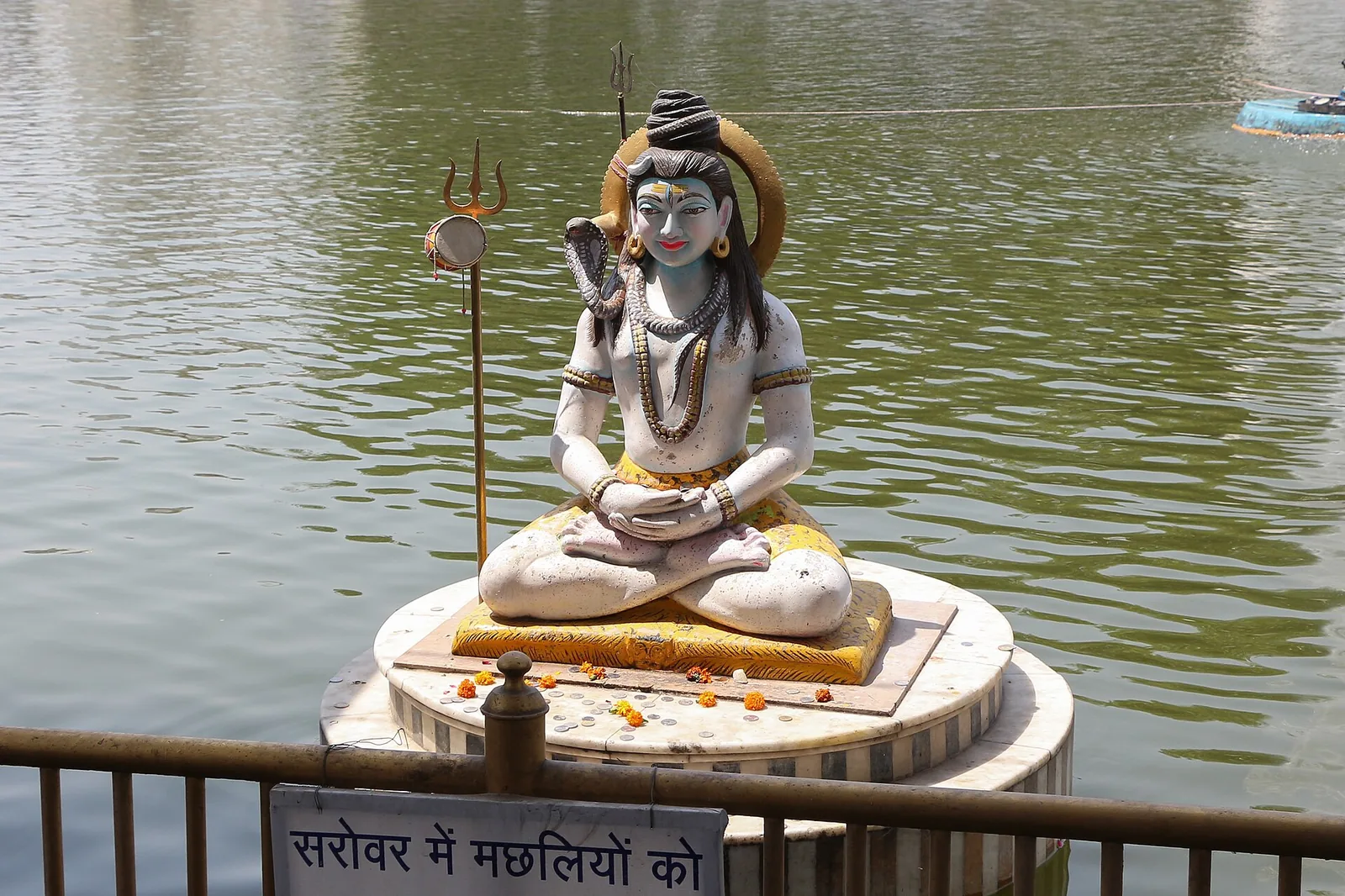 Durgiana Temple — Sacred Hindu Silver Temple Set in the Middle of a Holy Sarovar
6. The Partition Museum & Town Hall Oral History Archives (Heritage Street)
The world's first museum dedicated to the 1947 Partition of India, housed in the historic Town Hall. The 14 galleries preserve oral testimonies, personal memoirs, refugee artifacts, official letters, and art installations detailing the migration of millions across Punjab and Bengal.
7. Ram Tirth Ashram & Sage Valmiki Sacred Hermitage (11 km)
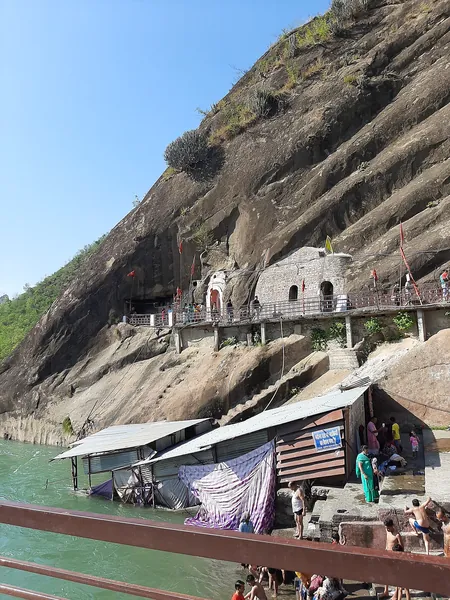
An ancient pilgrimage shrine located 11 km from Amritsar, believed to be the hermitage of Sage Valmiki where Goddess Sita took shelter after exile and gave birth to Luv and Kush. The site features a sacred stepped tank and a gilded temple.
8. Sadda Pind Living Punjabi Cultural & Culinary Heritage Village
A 12-acre resort complex recreating an authentic traditional Punjabi rural village, offering live Bhangra and Giddha performances, pottery workshops, camel rides, and farm to table Punjabi meals.
9. Heritage Street & Hall Bazaar Historic Spice and Textile Corridors
A 1 km paved pedestrian corridor leading from Town Hall to the Golden Temple, lined with Rajput and Mughal style facades, statues of Maharaja Ranjit Singh, and traditional bazaar shops selling Punjabi *juttis* and *phulkari* embroidery.
Popular Hotels in Amritsar
 Hotel
Hotel
 Hotel
Hotel
 Hotel
Hotel
 Hotel
Hotel
 Hotel
Hotel
 Hotel
Hotel
 Hotel
Hotel
 Hotel
Hotel
 Hotel
Hotel
 Hotel
Hotel
Top Places to Visit in Amritsar
Amritsar Photo Gallery & Attractions
Explore high-resolution photographs of iconic temples, historical monuments, and scenic landmarks in Amritsar.
Plan Your Amritsar Trip Now
Get the best verified hotel deals and customized tour packages. Book directly on EarthTrip and save up to 45%!